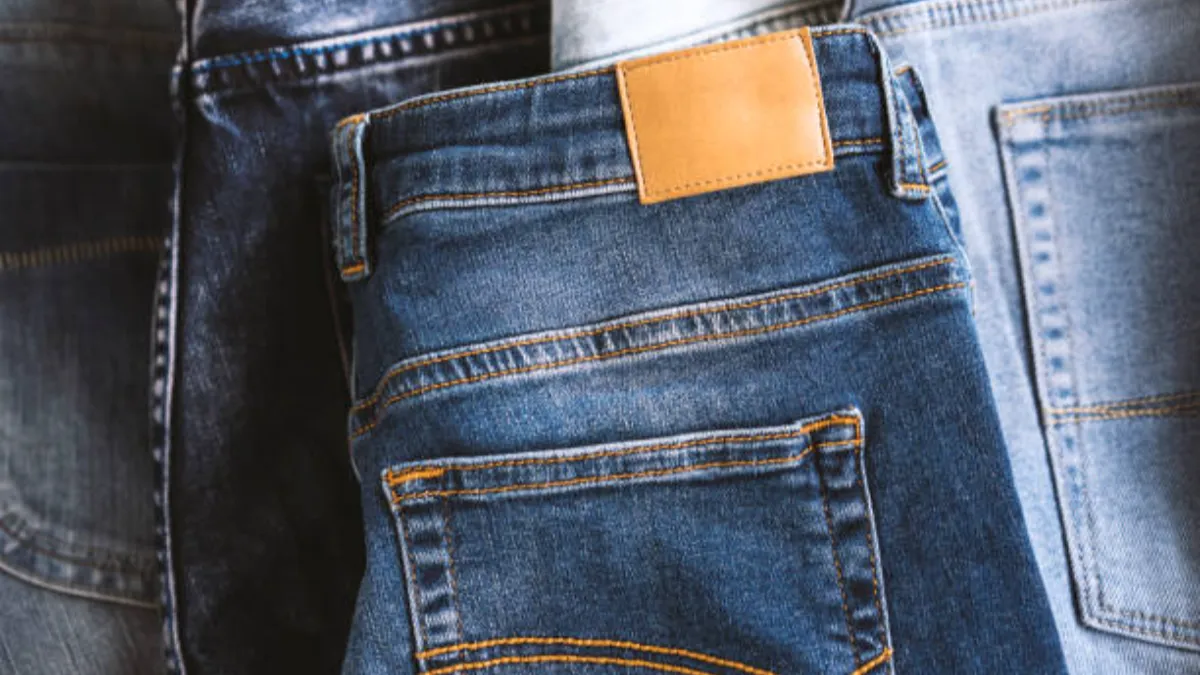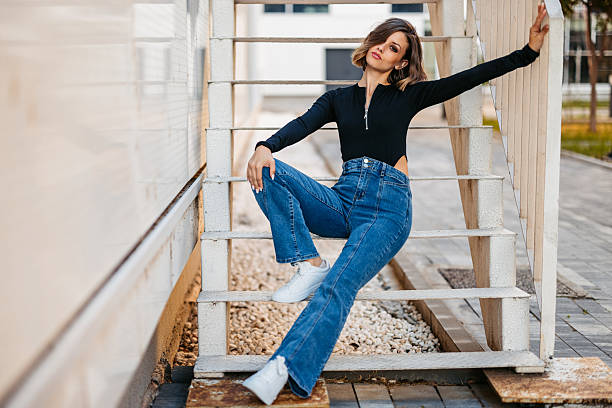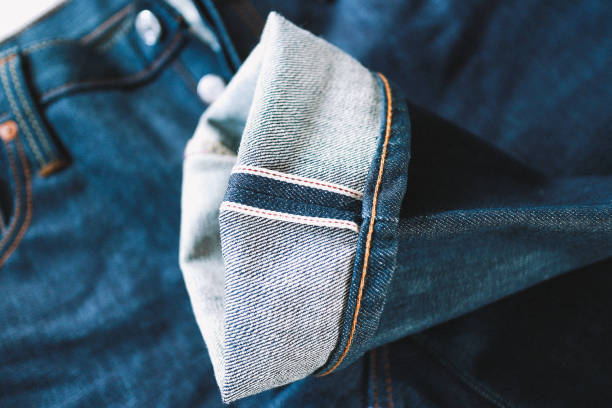
Denim washing and finishing are critical to defining the look, feel, and performance of jeans. Brands, designers, and buyers all rely on understanding the differences between the denim wet process and denim dry process to create consistent, high-quality products.
This comprehensive denim washing guide covers the types, principles, visual effects, and sustainability aspects of both wet and dry processes. The guide also provides actionable insights for sourcing from reliable denim manufacturers, ensuring your collection meets market expectations.
What Are Denim Wet and Dry Processes
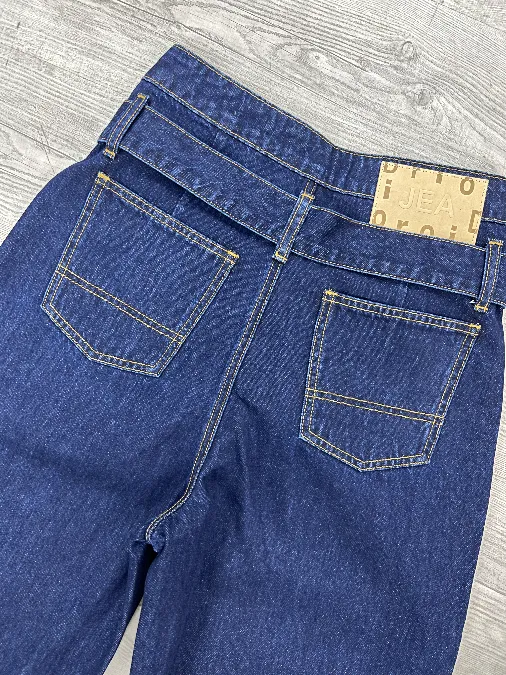
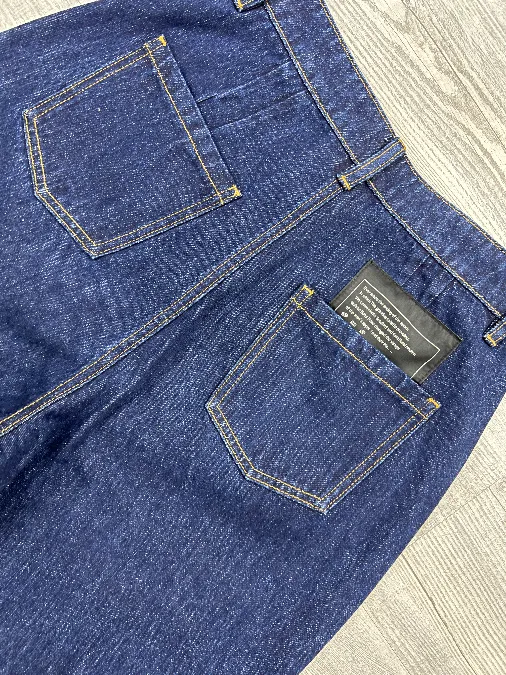
Denim finishing can be broadly categorized into two main stages: wet processing and dry processing. Both have distinct roles in achieving the desired garment quality.
Denim Wet Process
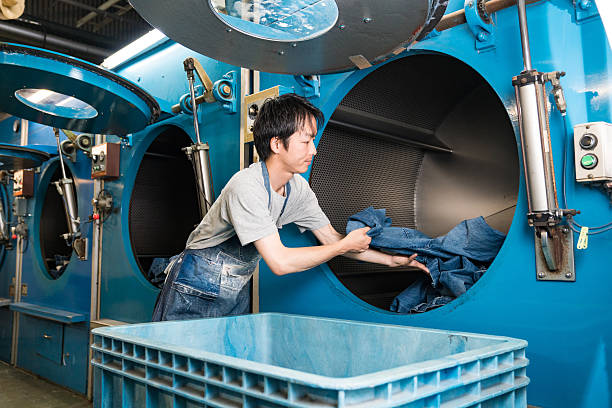
The denim wet process involves using water, chemicals, enzymes, or mechanical action to manipulate the fabric’s structure, color, and hand feel. It is typically carried out after garment sewing and is essential for:
- Color fading and shade adjustment
- Fabric softness
- Dimensional stability and shrinkage control
- Preparing the garment for subsequent finishing processes
Denim Dry Process
The denim dry process focuses on visual and surface effects applied after the wet wash. Techniques include abrasion, creasing, laser finishing, and resin application. Dry processing does not alter the fundamental structure of the fabric but enhances the garment’s aesthetic appeal by creating patterns, whiskers, or distressed textures.
Comparison Table: Wet vs Dry Process
| Feature | Denim Wet Process | Denim Dry Process |
|---|---|---|
| Purpose | Adjust fabric structure, color, and softness | Create visual effects and texture patterns |
| Method | Water, chemicals, enzymes, mechanical action | Hand/manual abrasion, laser, resin, mechanical tools |
| Stage | Post-sewing, pre-finishing | After wet washing and drying |
| Visual Impact | Uniform color fading, softened hand | Creases, whiskers, distressed edges, embossed textures |
| Impact on Fabric | Changes fiber properties, potential strength loss | Minimal impact on fabric strength |
| Common Techniques | Stone wash, enzyme wash, bleach wash, rinse & clean | Whiskers, grinding, hand scraping, laser distress, resin crinkle |
Overview of Types of Denim Wet Processes
| Process | Principle | Visual Effect | Key Considerations |
|---|---|---|---|
| Stone Wash | Tumbling with pumice stones | Soft vintage look with faded highlights | Can weaken fabric, batch variability, higher water usage |
| Enzyme Wash | Use of cellulase enzymes | Smooth, controlled fading | Environmentally friendlier than stones, needs precise control |
| Acid Wash | Stones with oxidizing chemicals | Dramatic contrast, high-low color | Fabric damage risk, chemical handling required |
| Light / Medium / Dark Wash | Duration and chemical strength | Overall light to dark shade | Balances color and softness, requires QC |
| Bleach Wash | Chemical oxidizing agent | Very pale, worn-out look | High risk of fiber weakening and yellowing |
| Rinse & Clean | Simple water rinse | Near-raw, minimal fading | Preserves fabric strength, minimal visual change |
| Overdye / Tint | Post-wash dye application | Unique custom shades | Adds flexibility but increases process complexity |
Major Types of Denim Wet Processes
Stone Wash
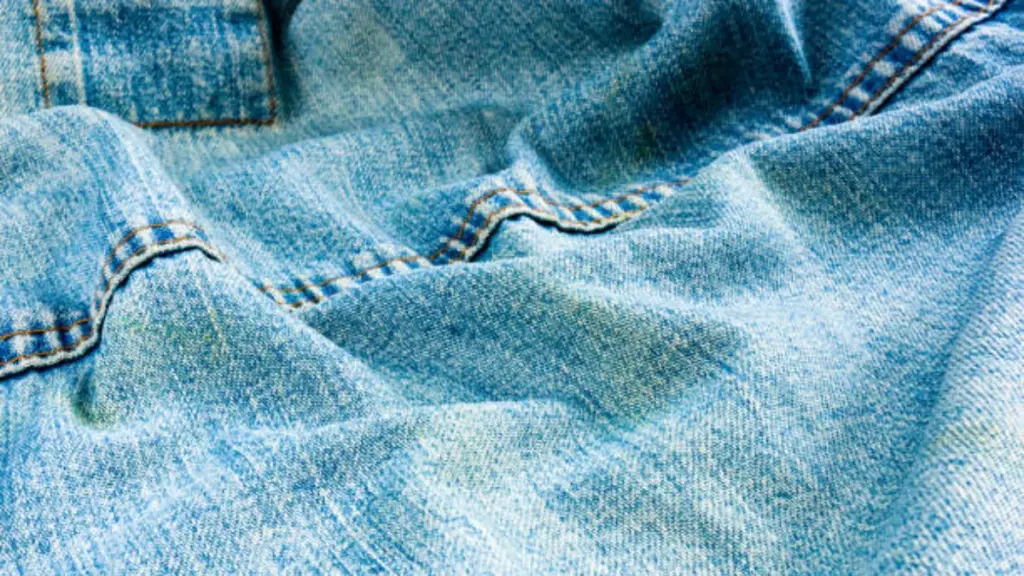
Stone wash is a traditional denim wet process where garments are tumbled with pumice stones. The friction abrades the indigo-dyed surface fibers, producing a worn, vintage look. This process softens the denim and reduces stiffness, giving a comfortable hand feel. The intensity of the wash can be controlled by the size and amount of stones, tumbling time, and mechanical rotation speed, allowing variations from light fading to heavy vintage effects.
| Pros | Cons |
|---|---|
| Creates natural, soft fading | Can weaken fabric fibers |
| Enhances garment comfort | Batch-to-batch variation possible |
Enzyme Wash
Enzyme wash uses cellulase enzymes to selectively break down cotton fibers on the denim surface. This controlled biochemical reaction removes indigo and creates smooth fading patterns while maintaining fabric strength. The process is more consistent than stone washing and can be precisely managed through enzyme concentration, temperature, and duration. It is often favored for premium denim to achieve reproducible fading without significant mechanical abrasion.
| Pros | Cons |
|---|---|
| Smooth, uniform fading | Requires precise control of enzyme activity |
| Less fiber damage than stone wash | Slightly higher processing cost |
Acid Wash
Acid wash combines pumice stones and oxidizing chemicals to remove indigo and produce high-contrast fading. The chemical reaction between the oxidizer and the indigo creates irregular light and dark areas, giving denim a dramatic, retro look. Process parameters such as chemical concentration, exposure time, and stone movement are carefully controlled to achieve consistent visual effects while minimizing fabric damage.
| Pros | Cons |
|---|---|
| Distinct high-contrast effect | Risk of fabric weakening |
| Trend-driven, visually striking | Requires careful chemical handling |
Light / Medium / Dark Wash
These washes adjust the depth of fading by controlling chemical strength, wash duration, and agitation. Light washes produce soft, faded denim, medium washes balance color and hand feel, and dark washes retain deeper indigo with minimal fading. This process allows brands to offer diverse style ranges from vintage-light to premium-dark denim, while maintaining consistent garment quality through careful quality control.
| Pros | Cons |
|---|---|
| Versatile range of shades | Requires precise QC for consistency |
| Balances color and softness | Longer processing time for uniformity |
Bleach Wash
Bleach wash applies chemical oxidizers to strip significant color from denim, creating very light tones and worn-out aesthetics. The concentration, exposure, and rinsing are carefully monitored to prevent excessive damage. It is ideal for fashion-forward, pale denim styles but must be controlled to maintain fabric integrity.
| Pros | Cons |
|---|---|
| Creates dramatic, pale denim | High risk of fiber weakening |
| Popular for trend-driven designs | May cause yellowing if uncontrolled |
Rinse & Clean
Rinse & Clean is a minimal wet process to remove starch, sizing, and surface impurities without significantly affecting color. This preserves near-raw denim aesthetics and maintains fabric strength, providing a clean, natural hand feel.
| Pros | Cons |
|---|---|
| Preserves fabric strength | Limited aesthetic effect |
| Maintains near-raw appearance | Not suitable for heavy fading |
Overdye / Tint Wash
Overdye or tint wash applies additional pigments after the base wash to create unique seasonal shades. This method allows for creative, customized colors and fashion-driven designs while maintaining fabric quality.
| Pros | Cons |
|---|---|
| Flexible color options | Requires precise control for consistency |
| Enhances fashion appeal | Adds process complexity and cost |
Overview of Types of Denim Dry Processes
| Process | Category | Principle | Visual Effect | Method |
|---|---|---|---|---|
| Hand Scrape / Hand Sanding | Manual Abrasion | Sandpaper applied by hand to jeans | Natural fading with layered depth | Skilled workers manually abrade areas like thighs, knees, pockets |
| Monkey Wash / PP Spray | Manual Abrasion | High manganese solution sprayed on target areas | Brighter, faster fading | Combines chemical reaction with manual targeting |
| Sandblast | Manual Abrasion | High-pressure air gun with abrasives | Rugged, heavily worn look | Largely replaced by laser due to health risks |
| Whiskers / Mustache | 3D Texture | Crease patterns at hips and thighs | Natural folds and fade lines | Manual or laser patterning |
| Grinding / Destructed | 3D Texture | Abrasion to edges and seams | Holes, fraying, worn edges | Machine or manual grinding |
| Resin / 3D Crinkle | 3D Texture | Resin application and high-temperature setting | Permanent folds with tactile depth | Spraying resin and heat setting |
| Tie Dye / Tagging | Patterning | Tying or suspending garments | Custom localized abrasion or dye patterns | Hand manipulation and chemical finishing |
Common Types of Denim Dry Processes
Manual / Mechanical Abrasion
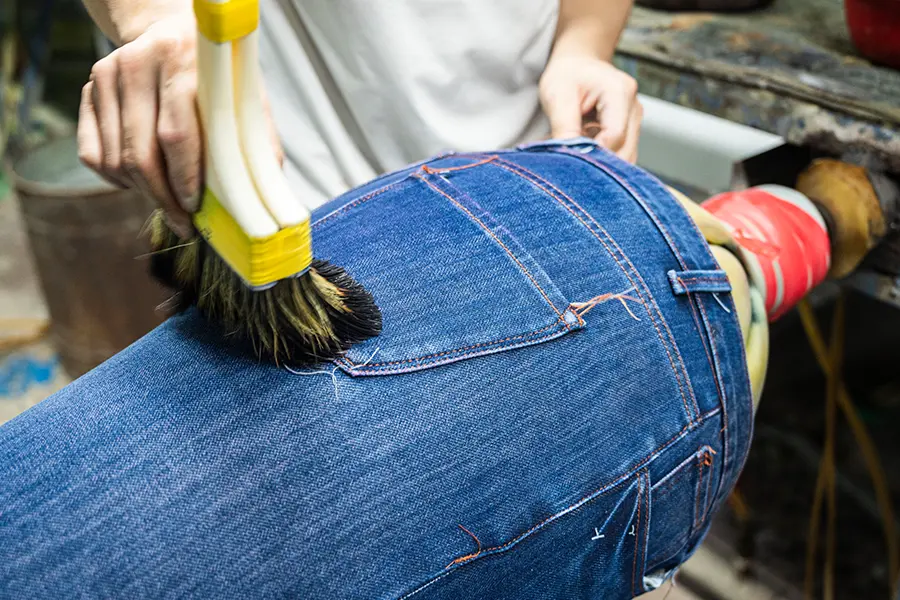
- Hand Scrape / Hand Sanding: Workers use sandpaper to manually abrade areas like thighs and hips, creating natural fading with layered depth. This premium technique emphasizes a worn-in, vintage look. Skilled labor is essential for consistency, ensuring realistic wear patterns and a soft hand feel.
- Monkey Wash / PP Spray: High-manganese solution is sprayed onto targeted areas, producing bright, rapid fading. Often combined with hand scraping, this method accelerates production while still achieving controlled highlight effects.
- Sandblast: High-pressure air mixed with abrasive material is applied to fabric, producing a rugged, heavily worn look. Due to health risks like silicosis, many brands have banned this method, with lasers gradually replacing it for safety and precision.
3D Texture & Destruction
- Whiskers / Mustache: Creates crease patterns at hips and thighs, simulating natural folds from prolonged wear. Can be applied manually or with lasers to achieve realistic 3D texture and depth.
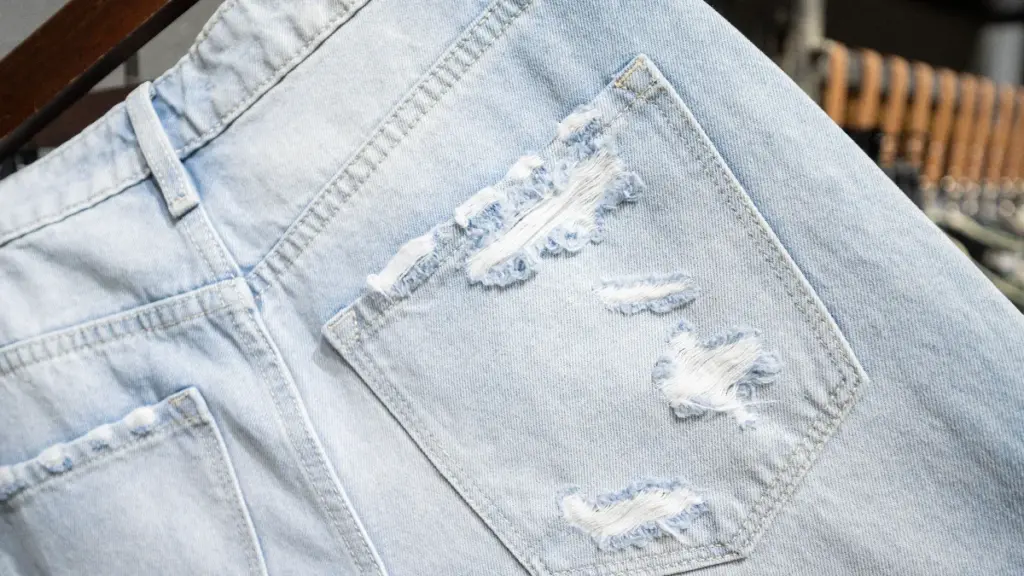
- Grinding / Destructed: Machines or hand tools abrade edges and seams, forming holes, frays, and worn areas. Popular in streetwear styles, it adds an intentionally distressed appearance.
- Resin / 3D Crinkle: Resin is applied to targeted areas and heat-set to form permanent 3D folds. Enhances both visual depth and tactile texture, creating durable design features.
- Tie Dye / Tagging: Garments are tied or suspended and treated with abrasion or dye to produce localized patterns. Adds customization and artistic effects for unique, visually engaging denim.
Custom Denim That Brings Your Brand to Life
The Sustainable Revolution in Denim Processing
The elephant in the room regarding denim processing is its environmental impact. Traditionally, the industry has been water-intensive and chemically reliant. However, a massive technological shift is underway, moving from “art via chemicals” to “art via technology.”
1. Laser Finishing
Laser technology is replacing hand sanding, whiskering, and destruction.
- The Benefit: A laser can burn a vintage pattern onto a pair of jeans in 90 seconds, a process that takes a human 10-15 minutes. It eliminates the dust from sanding and significantly reduces labor intensity.
2. Ozone Washing
Ozone (O3) gas is used to bleach denim without water.
- The Benefit: Ozone attacks the indigo molecule and then converts back into ordinary oxygen. It can strip color and clean “backstaining” (dirty pockets) with zero water discharge and zero chemical residue.
3. Nano-Bubble (E-Flow) Technology
Instead of filling a washing machine with thousands of liters of water, this technology creates a “fog” of nano-bubbles containing the chemical softeners or resins.
- The Benefit: It allows for the application of chemicals using a minimum amount of water (reducing water consumption by up to 95%) and ensures zero chemical waste.
4. Artificial Stones
To replace pumice stones (which mine natural resources and create sludge), the industry is moving toward synthetic abrasive eco-stones or reusable polymer spheres that abrade the denim without disintegrating.
Choosing the Right Wet and Dry Process for Your Denim Line
Selecting the right combination of wet and dry processes is a strategic decision that directly affects product quality, cost, scalability, and market acceptance. When evaluating finishing options, brands should focus on the following key factors:
- Target Market and Positioning
Premium, fashion-forward denim often requires controlled enzyme washes and detailed dry processes like whiskers or resin crinkle, while mass-market styles prioritize efficiency and durability. - Desired Visual Outcome
The final look matters. Uniform, clean fades rely more on wet processes, while vintage, worn-in, or distressed styles depend heavily on dry techniques. - Fabric Type and Construction
Heavier denim tolerates aggressive washing and abrasion better than lightweight or stretch fabrics, which require gentler, more controlled processes. - Cost and Production Scale
Complex process combinations increase unit cost and lead time. Brands must balance aesthetic goals with commercial feasibility. - Consistency and Quality Control
Some processes, especially manual dry techniques, require skilled labor to ensure repeatable results across bulk production. - Sustainability and Compliance
Water usage, chemical impact, and worker safety are increasingly important. Enzyme washes, laser finishing, and ozone technologies help brands meet environmental and regulatory expectations.
Final Thoughts
Mastering the intricate balance of denim wet and dry processes is essential, but having the right infrastructure is what turns that knowledge into profit. As the market demands higher sustainability standards and faster turnaround times, relying on outdated methods is no longer an option. Your machinery needs to be as advanced as your techniques.
At Changhong, we provide the industrial washing and dyeing solutions necessary to stay competitive in this evolving landscape. Whether you are upgrading a single machine or planning a complete facility overhaul, our experts are here to help you optimize efficiency and quality.
Ready to elevate your denim production line? Contact us today for a professional consultation, or explore our full range of textile finishing machinery to find the perfect solution for your business.